RSS — Friday, May 1, 2026
Kære Computer,
Have you ever used RSS for anything? I asked this question in a group chat a while ago. Although I posed this to my favourite circle of chronically online friends, answers varied. Only two people told me they use RSS readers regularly, the rest admitted to never having used it. "I feel VERY gen z, when I don't even know what it is?" one said. "Oh its just an abbreviation for Rizz Skipidi Slop. Hope this helps!" quipped another.
I knew I wanted to get into RSS for a while now, since Hanna asked me to co-create a workshop with her on the topic at SUPeR. Even though I knew already the gist of what an RSS feed is and absolutely buy into it conceptually, politically and practically, for some reason I kept postponing actually trying it out for literally months! When I finally set up a feedreader and started using it, it was a breeze and so well worth it. I learned from my small focus group that, even among the_nerds, people who are elder millennials or at least old at heart, are more likely to being RSS enthusiasts. I hope you will hop on the bandwagon, regardless of your comfort level with tech in general, or your relationship to skinny jeans and air fryers specifically. Consider this newsletter a guide to the What Why and How of RSS and my encouragement to give it a go.

What
Really Simple Syndication (RSS) is a standardized format for users and programs to send and receive updates. And as we look for alternatives ways to connect online, RSS feeds are options that give us back control over what we are presented with, and claw back data that we don’t want to give away through aggressive tracking that now pervades most online platforms.
RSS is the acronym for the cute name: Really Simple Syndication (or Rich Site Summary?). It is really simple! RSS is technically a file on your website / blog that lists and structures the content of it with a bunch of metadata, such as title, date of submission, and the URL that leads to the actual content. RSS is very particular with how this data is structured. The standardization of data is really what makes it so smart. It is guaranteed to come in a very particular format, anyone can make a program that reads any RSS and use it for any kind of project. Reading RSS will never change the original.
Because RSS is so convenient for passing information between websites, its use has become widespread to the point that it really is the vehicle for sharing content for the web. Chances are you have been consuming media via RSS feeds for a very long time already, even if you're not aware of it. RSS has been the dominant web feed that distributes podcasts since it added the option to carry audio files in 2000. When you want to listen to a show, you add the RSS feed to your podcast client, and the client can then list available episodes and download or stream them for listening or viewing. This is really the gist of it whether for podcasts, blogposts, news or youtube videos.
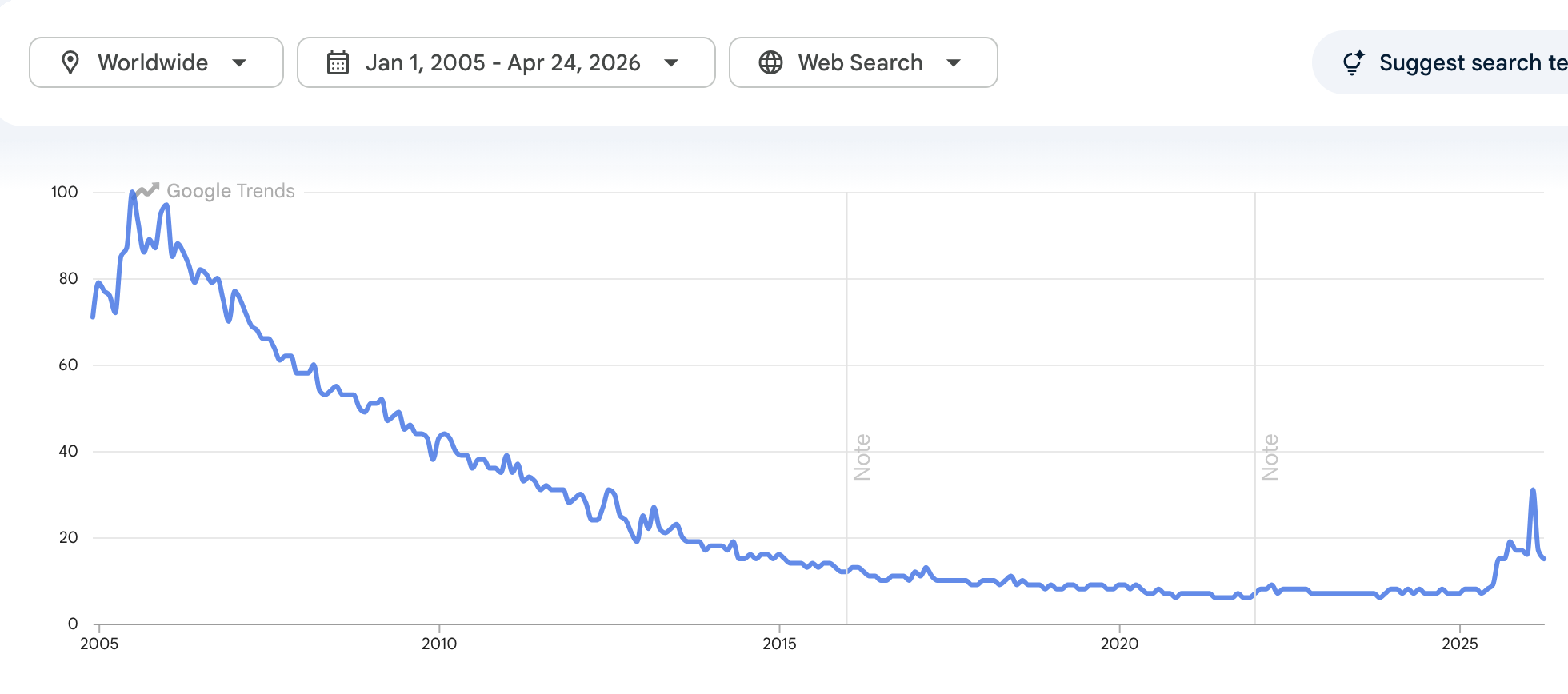
The popularity of RSS stems from the convenience of sharing information in a reliable and standardized format and how widespread it is. Regular folks may not know what it is (and look at this graph on the seach for "RSS" on Google from 2005 to today - not looking good), but its popularity is self-reinforcing. Even if RSS stops being used by consumers altogether, it will most likely be powering the back end of many websites and programs that primarily collect content from other places for a long time to come. The humble RSS protocol is alive and well!
Why
Ok cool cool, but why should I care about RSS and invest precious life energy into this?
We are spending more time online than ever before, we keep spending even more, and it is probably making us miserable. Some of you might be using that time for nice things but most of us pass hours everyday anxiously stuck inside services that increasingly limit external links and really our free movement on the internet. Platforms like Facebook/Instagram and Twitter all actively keep you from wandering the web like a digital garden and instead treat you liker a virtual prisoner to the endless doomscroll. A vanishingly small amount of content on your FYP is now from accounts you actually follow. We are foie-grass-duck-stuffed with aggregate snippets of information in AI 'overviews' and LLM summaries. Everything already went to hell in a handbasket. It gets harder and harder to find quality writing, creative expression and the output of people you care about and want to follow.
Of course you can subscribe to newsletters, and thats a wonderful way to circumvent the terrible-ness of the internet and listen directly to voices that you choose yourself. But increasingly every technology is spying on you and harvesting data on your behaviour to sell to the open market of postmodern ad-personalization. I don't mean every newsletter writer is doing this, but the platforms they let themselves and their intellectual property get locked into may well be. Apps like Substack platform literal nazis as well as collect your data to regurgitate back an algorithmic feed full of ads. Patreon is full of nonconsensual AI porn of real victims. Large commercial platforms routinely let us down and choose profit above all else (I use Ghost, an open source alternative).
Yady yady it all sucks, we know! But what if there was a way to fight back against the dull violence of the algo, to decide yourself what content you want to see and which voices to listen to, without being tracked, surveilled, smothered in AI and followed by sponsored ad content weaponized against your most sensitive data that has been extracted from you without consent? Good news, RSS makes the web bearable.
How
Firstly you need an RSS reader: the place where you read all you news. If we think back to the podcast example, you need a place to listen to podcasts and you have a choice and can pick the one you like, can afford, or that fits you device of choice. I pay for a subscription with Feedbin, which I really like. Here's a couple of suggestions for free readers: IOS app Feeed, Lire, Vienna, Inoreader. Don't worry too much about choosing. These are all fine. As Molly White put it: "RSS is a protocol, and switching feed readers later is straightforward."
Once you've picked your reader you need to add all the feeds you want to follow. Most readers will allow you to add new RSS feeds via a URL. You can simply paste the URL of your newsletter of choice (such as this one!). You can also add a traditional news publication, a blog, a youtube channel, a Bluesky or Mastodon feed or even a subreddit you enjoy. The world is your oyster! Molly made a really nice blogroll for inspiration that is heavily into tech and neo-luddite activism. I'll have to make one for myself soon. My list is currently a mix of tech criticism, antifascist gardening and knitting and sewing blogs.

AHHHHH!
When I finally started using a RSS reader it felt like instant relief. "It’s almost impossible to overstate how superior RSS is to the median web page", as Cory Doctorow wrote. No more distractions or disruptions, dark design patterns, no inbox full of guilt-inducing prompts that pull my focus from the newsletter or article I'm trying to enjoy. What this new quietude did to me felt profound. Since switching to reading newsletters and blogs in RSS format, I have been reading more than ever. I have been engaging with the material in a deeper way, and in return felt more inspired to create. RSS causes less stress, and allowed me rediscover how much I love reading.
This is a new way of engaging with the web. You're not being bombarded with information or looking for the needle (person you follow) in the haystack (algorithm). Information is a stream of media that you can enjoy at anytime you like.
Support
The only flipside to all of this is how much it emphasizes our responsibility to support writers and creators we care about, whenever possible. The RSS feed severs a kind of bond that used to exist between newsletter writer and reader. If you read this text for example in an RSS reader, I'll never know about it. I added the RSS stream to my blog and now anyone may 'subscribe' to it without me ever knowing about it. In our crumbling old-media-landscape authors use their social media numbers to land book deals or paid writing gigs. Its understood that even if you don't support an independent writer monetarily, you're still vaguely doing 'something' by juicing their numbers on social media with engagement. I'm keenly aware that when I unsubscribe my email in Substack and resubscribe in RSS, I no longer count as metric the writer can meaningfully leverage in any kind of way. I don't have a good answer to fix this problem other than to sign up for a paid subscription or make a one-time contribution to writers that I regularly read. I have mixed feelings about this, but I can honestly tell you, dear reader, than I'd be delighted for you to read my newsletter as an RSS feed. You mean more to me than data, sweet pea!
I learned through research for this workshop that Aaron Swarz helped develop RSS web feeds at the ripe old age of 14! I want to end this with a few words from Aaron who spoke succinctly on the decentralized many-to-many topology of network communication in 2007, where he connected the change in the architecture of media with the change in the architecture of control. Watch this short video, please! It may be nearly 20 years old, yet it is also beamed to us directly from the future somehow, explaining how we can have nice things. "For EVERYTHING, there's someone who cares a great deal about it (...) the internet provides a way for you to get in touch with those people who really care about this completely obscure thing."
BUILD SUCCESS,
graceful shutdown,
LOL,
Nynne